Los Angeles, California
Los Angeles: City of Angels
Where dreams are manufactured, cultures collide, and 284 sunny days a year invite outdoor adventure — Los Angeles is sprawling, surprising, and perpetually reinventing itself.
Explore This GuideLos Angeles Travel Guide 2026
Hollywood, Beverly Hills, Santa Monica, Venice Beach, Griffith Observatory, world-class museums, and one of the planet’s great food cities — plan a smarter LA trip with neighborhood depth, practical getting-around advice, and the landmarks that define Southern California.
Los Angeles: A World in One City
Los Angeles is perhaps the most misunderstood major city in the world. Dismissed by detractors as shallow, traffic-choked, and culturally thin, LA reveals extraordinary depths to anyone willing to look past the clichés — and what they find consistently astonishes them.
Los Angeles County is home to approximately 10.1 million people — more than the population of 40 individual U.S. states — making it by far the most populous county in the United States. The city itself, at 503 square miles, is the second-largest in the United States by area (after Anchorage, Alaska). Within its boundaries live people from virtually every nation on Earth, speaking over 200 languages, practicing every religion known to humanity, and bringing with them the full diversity of global culture.
This extraordinary diversity is not incidental to Los Angeles’s character — it is its character. Neighborhoods reflect decades and centuries of immigrant communities establishing their own cultural spaces: Koreatown, the largest Korean community outside Korea; Little Tokyo, preserving Japanese-American culture through a century of adversity; Tehrangeles (Westwood and Beverly Hills), home to the largest Persian diaspora community outside Iran; Boyle Heights, the heart of Los Angeles’s Mexican-American culture; and Leimert Park, the creative hub of LA’s African-American community. To travel through Los Angeles is to travel through the world.
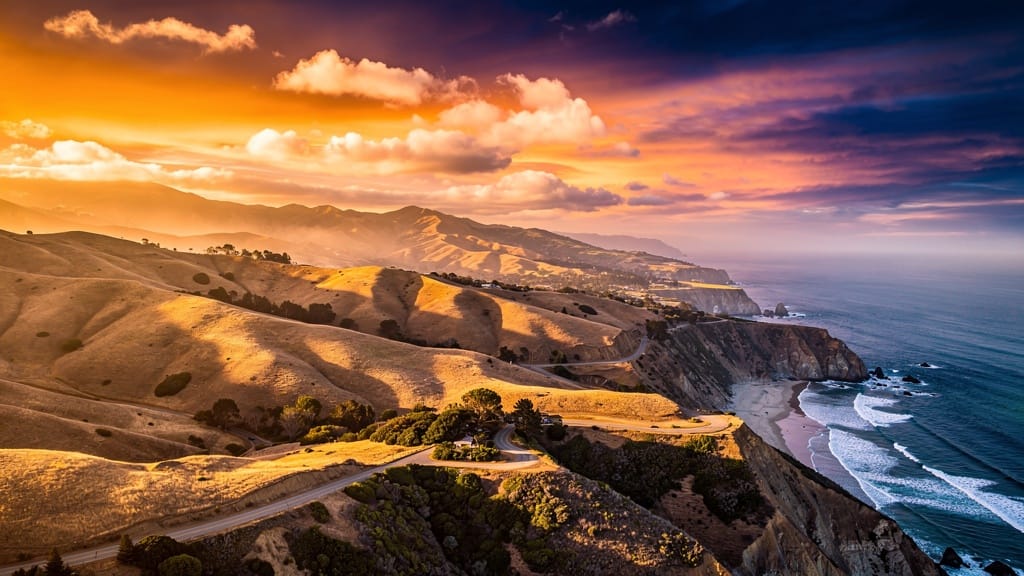
Against this human backdrop stands one of the world’s most striking physical settings. The Los Angeles Basin is bounded by the Santa Monica Mountains to the north, the San Gabriel Mountains to the east, the Puente Hills to the southeast, and the Pacific Ocean to the west. Mountain ranges, coastal mesas, river corridors, and ocean frontage create a landscape of perpetual drama — particularly at sunset, when light off the Pacific turns the sky into orange, pink, and purple that seems almost too beautiful to be real.
Hollywood: The Dream Factory
Entertainment capital of the world — neighborhood, industry, and global metaphor since the 1910s.
Hollywood — both the neighborhood on the northern slopes of the Santa Monica Mountains and the global metaphor for the American entertainment industry — has shaped popular culture since the 1910s, when the young film industry relocated from New Jersey to Southern California in search of year-round sunshine and varied locations.
Today, the Los Angeles metropolitan area hosts the headquarters of all six major Hollywood studios, three major television networks, hundreds of independent production companies, and the infrastructure of the world’s dominant entertainment industry.
Hollywood Walk of Fame
The Hollywood Walk of Fame stretches along Hollywood Boulevard and Vine Street with over 2,700 five-pointed terrazzo and brass stars honoring achievements in entertainment. Stars run continuously from Gower Street to La Brea Avenue on Hollywood Boulevard and from Yucca Street to Sunset Boulevard on Vine Street. Each star is approximately 18 inches in diameter and bears the honoree’s name in bronze. Receiving a star requires a formal application, a nomination fee, and the honoree’s agreement to attend the dedication ceremony. Walking the Walk of Fame is free — a remarkable experience for film and television enthusiasts of any age.
TCL Chinese Theatre
Grauman’s Chinese Theatre (now TCL Chinese Theatre), on Hollywood Boulevard, has been one of Hollywood’s most recognizable landmarks since its 1927 opening. The theater’s forecourt holds the famous cement blocks bearing the handprints and footprints of over 200 Hollywood celebrities — from Mary Pickford and Douglas Fairbanks (first impressions in 1927) to later inductees including Leonardo DiCaprio and Jennifer Lawrence. Inside, the theater remains an active cinema with a magnificent atmospheric interior, still screening major releases in historic style.
Pair the Walk of Fame with a studio experience, a hillside viewpoint of the Hollywood Sign, and an evening screening on the Boulevard for a full entertainment-day arc.

Walk of Fame
More than 2,700 terrazzo and brass stars honor film, TV, music, radio, and live theatre along Hollywood & Vine.
Free to walk →

TCL Chinese Theatre
Handprints, footprints, and a working cinema in one of Hollywood’s most photographed landmarks since 1927.
Landmark stop →

Studio Culture
Major studios, networks, and independent production companies still anchor LA as the entertainment capital.
Industry core →
Beverly Hills, Bel Air & the West Side
West of Hollywood, Los Angeles shifts into polished residential glamour. Beverly Hills is synonymous with luxury retail, celebrity homes, and carefully manicured boulevards. Rodeo Drive remains the district’s signature shopping street — a concentrated stretch of flagship fashion houses, jewelers, and people-watching that defines the global image of LA wealth.
Bel Air and the surrounding hills offer gated estates, winding canyon roads, and some of the most valuable residential real estate in the United States. Visitors come for scenic drives, upscale dining, and the contrast between hillside privacy and the showmanship of nearby Sunset Boulevard.
Further west, Westwood blends UCLA’s academic energy with museums, cinemas, and the Persian cultural corridor often called Tehrangeles — home to the largest Persian diaspora community outside Iran. Together, Beverly Hills, Bel Air, and the broader West Side form a polished counterpoint to Hollywood’s neon and Downtown’s density.
- Rodeo Drive and the Golden Triangle for flagship shopping and architecture
- Sunset Boulevard corridors linking studios, hotels, and hillside viewpoints
- Westwood Village and UCLA for campus walks and cultural stops
- Scenic canyon drives toward Bel Air and the Santa Monica Mountains

Santa Monica & Venice Beach
Pacific air, pier lights, boardwalk culture, and the classic Southern California shoreline day.
Santa Monica is Los Angeles’s polished beach city: a walkable downtown, the historic Santa Monica Pier, broad sands, and an easy base for travelers who want ocean time without leaving the metro. The pier’s amusement rides, aquarium, and sunset views make it one of the most visited coastal landmarks in California. Third Street Promenade and the surrounding streets add shopping, dining, and a compact evening scene.
Just south, Venice Beach flips the mood. The boardwalk is pure LA theater — street performers, skate culture, Muscle Beach, murals, and a parade of locals and visitors that has defined California cool for generations. Canals inland from the beach offer a quieter, almost European pocket of footbridges and bungalows, while Abbot Kinney Boulevard concentrates independent shops and restaurants.
Together, Santa Monica and Venice deliver the classic LA coastal day: morning beach walk, pier or boardwalk energy, late lunch with ocean air, and a golden-hour finish on the sand. On 284 sunny days a year, these shores are not a side trip — they are central to how the city lives outdoors.
Build a coast day that links Santa Monica Pier, the beach path south to Venice, and a golden-hour return along Ocean Avenue or the boardwalk.

Santa Monica
Pier rides and views, wide public beach, Third Street Promenade, and a refined base for oceanfront mornings and easy evenings.
Venice Beach
Boardwalk performers, Muscle Beach, skate culture, street art, canals, and Abbot Kinney’s independent dining and retail strip.
Griffith Observatory & Griffith Park
Griffith Park is one of the largest urban parks in the United States — a rugged sweep of trails, brushy hillsides, and city overlooks rising above central Los Angeles. At its most famous crest sits Griffith Observatory, an Art Deco landmark that doubles as a public astronomy museum and the single best elevated viewpoint over the Los Angeles Basin for many first-time visitors.
From the observatory terraces, the Hollywood Sign, Downtown towers, and — on clear days — the Pacific come into a single panorama. Inside, exhibits, telescopes, and the planetarium make the stop as educational as it is scenic. Trails lace the surrounding park for hikers who want a longer approach, while the drive up remains one of LA’s essential visitor routes.
Sunset is the signature time: the same Pacific light that paints the basin orange and purple turns the observatory lawns into a communal viewing deck. Arrive early on weekends, bring layers for cooler hillside air, and pair the visit with a Hollywood day or a Griffith Park trail if you want more than the viewpoint alone.
- Panoramic terraces facing the Hollywood Sign and basin skyline
- Public astronomy exhibits and planetarium programming
- Hiking routes through Griffith Park’s extensive trail network
- Golden-hour and after-dark city-light views on clear evenings
Los Angeles’s World-Class Museums
From encyclopedic collections to architecture-forward campuses, LA’s museum scene rewards slow days and repeat visits.
Encyclopedic Collections
Major institutions span ancient to contemporary art, decorative arts, and rotating international exhibitions across the metro.
Plan a museum day →
Contemporary & Modern
LA’s modern and contemporary scene mirrors the city’s creative industries — bold architecture, film-adjacent media, and living artists.
See modern LA →
Science & Culture
Observatory exhibits, natural history, film heritage, and cultural museums extend far beyond a single “art afternoon.”
Go broader →
Campuses & Gardens
Several destinations pair galleries with gardens, courtyards, and hillside settings that feel like destinations in themselves.
Linger outdoors →
Treat museums as neighborhood anchors: cluster a morning gallery visit with nearby dining in Mid-Wilshire, Downtown, or the West Side rather than racing coast-to-coast between institutions. Reservations and timed entry are common at headline exhibitions — book ahead in peak seasons.
Los Angeles: One of the World’s Great Food Cities
Global kitchens, immigrant corridors, chef-driven dining, and casual brilliance on nearly every block.
Los Angeles belongs on any shortlist of the world’s great food cities. The same diversity that defines its neighborhoods fuels an unmatched dining landscape: Korean barbecue and late-night noodles in Koreatown, sushi counters and omakase temples, Mexican classics from Boyle Heights to East LA, Persian feasts in Tehrangeles, Japanese traditions in Little Tokyo, soulful cooking around Leimert Park, and chef-driven restaurants that draw international attention year after year.
Street-level LA eating is half the pleasure — taco stands, dumpling houses, seafood counters, bakery lines, and food halls reward curiosity more than rigid reservations. At the high end, tasting menus and destination dining rooms sit comfortably beside decades-old family institutions. Farmers markets and California produce culture keep menus seasonal even in a city famous for year-round sunshine.
For travelers, the winning strategy is geographic: pick a neighborhood, eat where that community eats, and let the next meal pull you across town. Hollywood may manufacture dreams, but Los Angeles’s kitchens manufacture the daily reason many visitors extend their stay.
Koreatown
Barbecue, banchan spreads, bakeries, and some of the city’s best late-night energy in the largest Korean community outside Korea.
Little Tokyo
Japanese-American heritage dining, cafes, and cultural stops in a compact Downtown-adjacent district with deep history.
Eastside Flavors
Boyle Heights and surrounding areas anchor Mexican-American food traditions that are essential to understanding LA’s table.
West Side & Coastal
Persian restaurants in Tehrangeles, refined Santa Monica seafood, and Venice’s inventive neighborhood dining strip.
Chef-Driven LA
Reservation-worthy tasting rooms and modern California restaurants that keep the city on global culinary shortlists.
Markets & Casual
Farmers markets, food halls, taco stands, and bakery lines — often the most memorable meals of a first visit.
Exploring Los Angeles’s Distinct Neighborhoods
LA is not one skyline — it is a constellation of cultural districts, each with its own rhythm, cuisine, and identity.
Koreatown
The largest Korean community outside Korea — nightlife, spas, barbecue, and dense urban energy between Downtown and Hollywood.
Cultural core →
Little Tokyo
Japanese-American culture preserved through a century of adversity — temples, shops, museums, and destination dining.
Heritage walk →
Tehrangeles
Westwood and Beverly Hills form the heart of the largest Persian diaspora community outside Iran — cafes, bakeries, and hospitality.
West Side flavor →
Boyle Heights
The heart of Los Angeles’s Mexican-American culture — murals, markets, family restaurants, and deep Eastside roots.
Eastside story →
Leimert Park
Creative hub of LA’s African-American community — music, art, performance, and neighborhood institutions with lasting influence.
Arts & culture →
Coast & Core
Hollywood, Downtown, Santa Monica, and Venice round out a first-timer’s map — entertainment, skyline, and shoreline in one metro.
Classic circuit →
To travel through Los Angeles is to travel through the world. Build itineraries neighborhood by neighborhood instead of landmark by landmark, and the city’s true scale — human as much as geographic — comes into focus.
Getting Around Los Angeles
LA is vast. Smart routing, realistic timing, and the right mix of car, rail, and rideshare make the difference between friction and flow.
Rental Car Reality
A car remains the most flexible way to link beaches, hills, and spread-out neighborhoods — but factor parking costs, peak freeway congestion, and longer-than-map drive times into every plan.
Metro & Rail
Metro rail and bus lines increasingly connect Downtown, Hollywood, Santa Monica, and major corridors. Use transit when your day clusters along a single line and save the car for canyon or multi-neighborhood swings.
Rideshare & Taxis
Rideshares excel for nights out, airport transfers, and skipping parking at popular venues. They add up across a full week, so mix modes rather than relying on one option alone.
Think in Clusters
Group Hollywood with Griffith Park, Santa Monica with Venice, and museum districts with nearby dining. Cross-town leaps at rush hour are the fastest way to lose an afternoon.
Airports & Arrival
LAX is the primary international gateway; other regional airports can simplify specific itineraries. Build buffer time for traffic between terminals, hotels, and first-night dinner plans.
Walking Pockets
Santa Monica, parts of Hollywood, Downtown districts, and neighborhood main streets are walkable once you arrive. LA rewards local wandering even when the metro overall is car-scaled.
Practical Visitor Information
Use these essentials to turn inspiration into a workable Los Angeles itinerary for 2026.
Best Time to Visit
Mild temperatures and 284 sunny days support year-round travel; spring and fall often balance beach weather with lighter crowds than peak summer.
How Long to Stay
Three full days cover Hollywood, a coast day, and one museum or neighborhood deep-dive. A week lets you add West Side polish, food corridors, and slower evenings.
Where to Base
Santa Monica for ocean access, Hollywood for entertainment density, Beverly Hills/West Side for polished stays, or central neighborhoods for food-first itineraries.
Signature Combo Days
Hollywood + Griffith Observatory; Santa Monica Pier + Venice Boardwalk; museum morning + Koreatown dinner; Rodeo Drive + sunset coast drive.
What to Budget For
Parking, rideshares, attraction tickets, and destination dining add up. Free highlights — Walk of Fame, many viewpoints, neighborhood wandering — stretch any budget.
Traveler Mindset
LA rewards curiosity past the clichés. Look past traffic jokes and postcard icons, and the city’s cultural depth, landscape drama, and reinvention come through.
Keep Exploring California
Pair Los Angeles with beaches, national parks, Northern California cities, and broader Golden State planning on california.in.
California Home
Return to the main 2026 guide for destinations, experiences, itineraries, and statewide travel essentials.
San Francisco Guide
Contrast LA’s sprawl with Bay Area neighborhoods, bridges, and compact city days in Northern California.
Beaches
Widen the coastal plan beyond Santa Monica and Venice to surf towns, cliffs, and Pacific favorites statewide.
National Parks
Add Yosemite, Joshua Tree, Sequoia, Death Valley, and other park landscapes to a Southern California base.
Road Trips
Connect Los Angeles with San Diego, the Central Coast, or a longer Pacific Coast and parks itinerary.
Food & Cities
Use LA’s global table as a springboard into California’s wider dining, wine country, and urban culture coverage.
Stay in the Know
Subscribe for new destination guides, seasonal recommendations, practical planning advice, and California travel inspiration.